


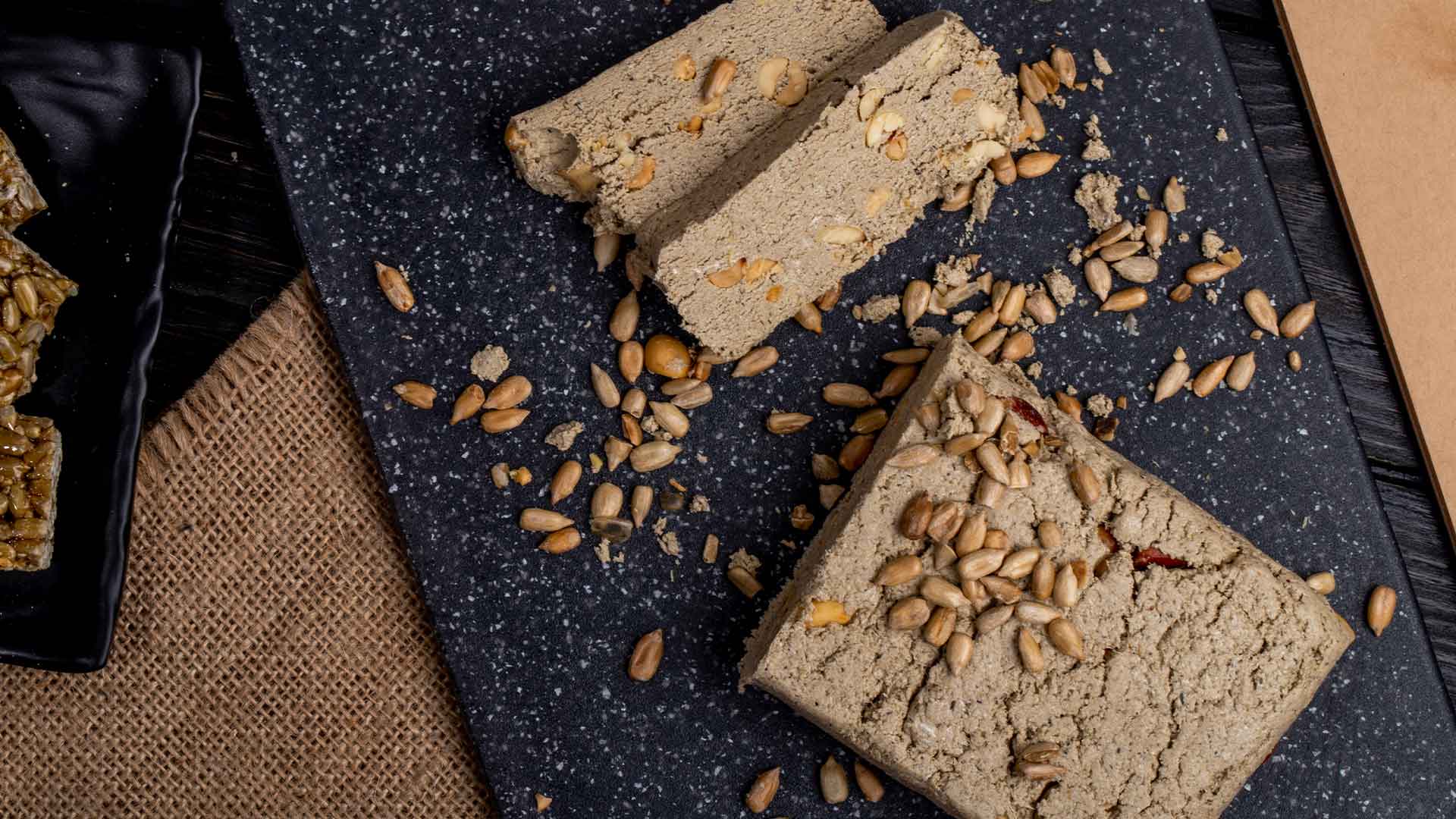
We can safely say that one of the most obvious differences between the Oghab Halva product group and other products on the market is the healthy production process of these products in accordance with international standards. First, we will start with the sesame processing process and then we will briefly explain the process of producing sugared halva.
Sesame processing process at the Oghab Halva factory
First stage: Checking the quality of sesame
In the first stage, when the sesame load arrives at the factory, the quality of sesame is first examined from various aspects to confirm its quality. After various tests are performed and the quality of sesame is confirmed, the next stages are carried out in the following order.
Second stage: Cleaning sesame
The process of cleaning sesame seeds is carried out in a device called a thresher using air suction and a sieve. The sesame load is transferred to the upper part of the thresher through a tank and a lift, and when it falls into the thresher, it is affected by an air suction flow whose speed can be adjusted; in such a way that light impurities, such as straw and stubble, leaves, unripe seeds and dust, are removed with the air flow. In the next stage, in order to separate other impurities, sesame seeds are spread on sieves. The vibrating movement of the sieves, while helping to move forward, spreads the sesame seeds on the surface of the sieves and increases the quality of separation.
Step Three: Sesame Hulling
Hulling is a step that is neglected in many other manufacturing companies on the market. In this step, the skin of the sesame seeds is separated from its kernel. This process helps to have a uniform color and a taste without bitterness. In addition, husking removes the indigestible fiber of the sesame, increases its nutritional value and minimizes the amount of chemical contaminants.
Step Four: Sesame Roasting
The next step is the roasting process. Heating the sesame seeds reduces moisture and thus reduces the possibility of mold and spoilage of the sesame seeds; in addition, it provides the conditions for the production of sesamol, which is the main antioxidant of sesame seeds. Also, in this stage, the appropriate smell and taste are created in the sesame seeds due to heat. Following this stage, without wasting time, the sesame seeds undergo a cooling process. This process is carried out using a cold air flow and prevents the oil from escaping from the sesame tissue.
Fifth stage: Separation
The fifth stage is the separation stage. In this stage, the sesame seeds are separated from each other in terms of color. This process is carried out in the Oghab Halva Factory with the help of color sorting devices or Color Sorter and using color-sensitive sensors. In this device, the sesame seeds are passed by nozzles in front of the color-sensitive sensors and are defined based on the color range, and finally, the seeds that have a color outside this range are removed from the path with air pressure. This device is mostly used to separate unpeeled seeds that have a different color from white sesame without skin.
Process of producing sugary halva in the Oghab Halva Factory
After completing all the above steps, the sesame is ready to be transformed into various sesame products. One of these products is Oghab sesame Halva. The preparation of Oghab sesame Halva follows the same recipe as making Tahini Halva, which is a mixture of Tahini (ground sesame) with cooked molasses, which is usually made with cardamom, rose water, and other edible nuts. You may be interested to know that in order to achieve a uniform and suitable texture, part of the work is done traditionally. Perhaps the word Hand Made would be better for this part of the Tahini Halva production process. In this part, skilled, professional people familiar with traditional techniques are used to prepare the halva. One of the reasons for cooperating with professionals familiar with traditional methods is the importance of entrepreneurship for managing the Oghab Halva collection.
As we mentioned earlier, a healthy production process in accordance with international standards, careful selection of quality raw materials, sesame cleaning, peeling, roasting, advanced sesame separation, use of traditional methods for preparing halva, and a general focus on a healthy production process are all among the things that distinguish Oghab sesame Halva from other halva available on the market.
Halva group, sesame group, sesame bar group, sesame cream group, sesame sauce group, tahini group, sesame oil group, and peanut butter group are all product groups of Oghab sesame Halva Factory, which are offered to the market in different flavors and packaging, taking into account different tastes and preferences.